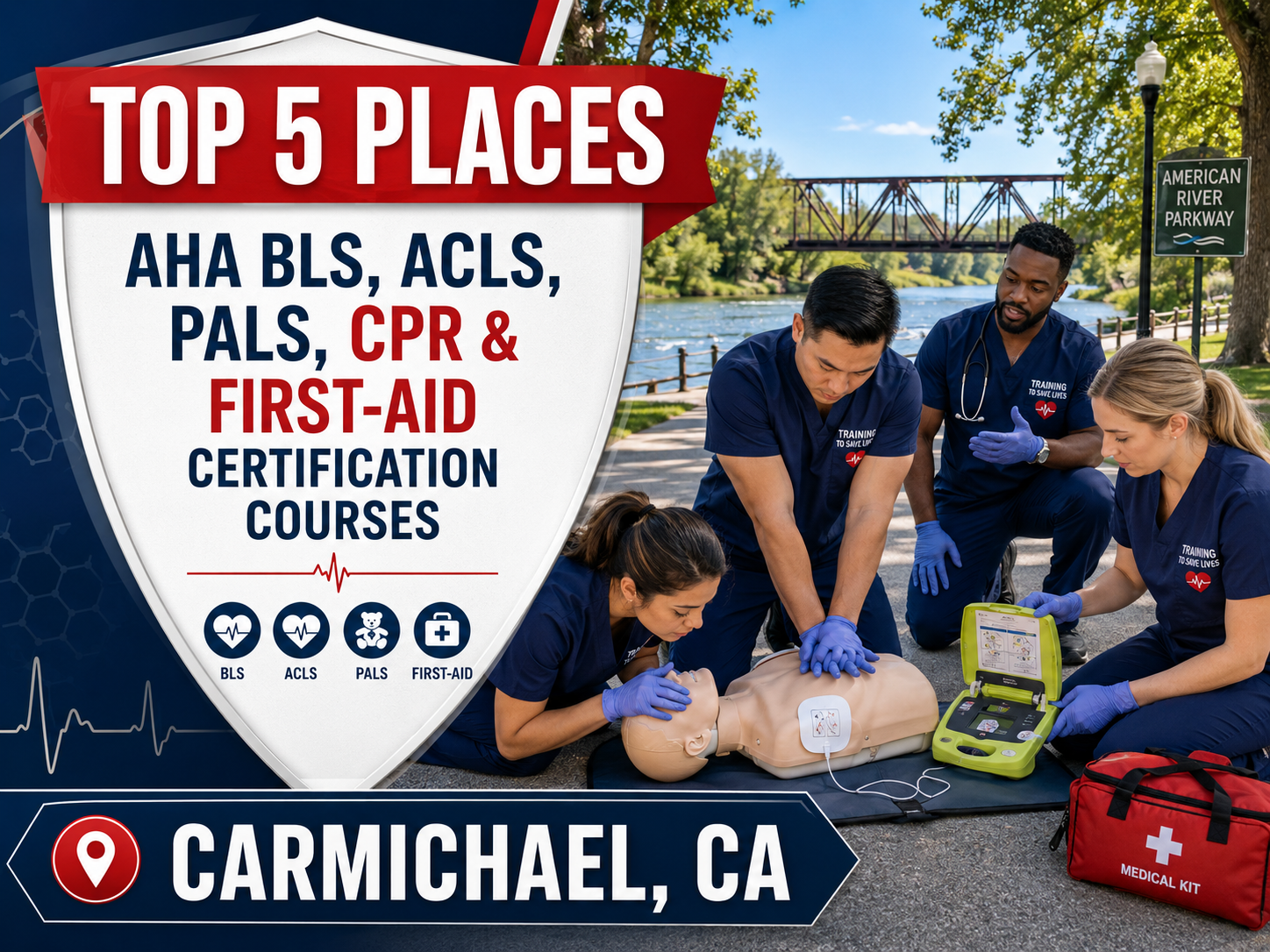
Flexible certification options through American Heart Association (AHA) Self-Guided Learning allow healthcare providers, school staff, and local professionals in Carmichael to balance rigorous training with demanding schedules. By completing foundational cognitive modules online through HeartCode® or eLearning platforms and finishing mandatory hands-on skills evaluations locally, learners obtain official AHA credentials without spending entire days in a traditional classroom setting.
Key Takeaway: AHA Self-Guided Learning pairs independent, online cognitive instruction with an in-person, hands-on skills session to meet complete certification standards. Before enrolling, verify whether your employer, school, or licensing board requires BLS, ACLS, PALS, or general CPR/First Aid training.
What Is AHA Self-Guided Learning?
AHA Self-Guided Learning is a blended instructional model designed to provide flexibility while maintaining the clinical standards set by the American Heart Association. Instead of sitting through hours of lectures in a group setting, students work through web-based simulations, videos, and scenario assessments at their own pace.
This training pathway consists of a structured process:
- Cognitive Module: Register for and complete the web-based coursework (such as HeartCode BLS, ACLS, or PALS) on an internet-connected device.
- Practice and Simulation: Navigate interactive patient scenarios and answer assessment questions independently.
- Hands-On Skills Verification: Attend a scheduled, in-person skills session to demonstrate chest compressions, airway management, AED operation, or advanced interventions on a specialized manikin.
- Credentialing: Receive an official AHA eCard upon successful completion of both the online coursework and the physical skills test.
Crucially, Self-Guided Learning differs from pure “online-only” CPR certificates. Most healthcare institutions, regulatory boards, and OSHA workplace safety guidelines do not accept cards issued by websites that lack physical skill evaluations. The blended format bridges this gap by ensuring hands-on competency while preserving schedule flexibility.
AHA Self-Guided Learning Course Options
Different professional roles require specific emergency care competencies. The AHA offers several distinct self-guided tracks tailored to various practice environments and emergency management responsibilities.
Basic Life Support (BLS) for Healthcare Providers
Basic Life Support focuses on high-quality cardiopulmonary resuscitation, automated external defibrillator (AED) integration, and airway obstruction relief for adult, child, and infant patients. Designed primarily for clinical settings, BLS teaches both single-rescuer and multi-rescuer team dynamics.
In Carmichael, BLS certification is routinely sought by:
- Registered nurses, nurse practitioners, and licensed vocational nurses
- Dental professionals and clinical hygienists
- Paramedics, EMTs, and emergency medical responders
- Nursing students, medical students, and allied health trainees
- Physicians, physician assistants, and physical therapists
Unlike general public CPR, BLS emphasizes pulse checks, bag-mask ventilation, team resuscitation roles, and advanced airway support recognition.
Advanced Cardiovascular Life Support (ACLS)
ACLS expands upon foundational BLS skills to cover urgent management of adult cerebrovascular and cardiovascular events. The self-guided HeartCode ACLS platform guides clinicians through simulated patient cases involving cardiac arrest, acute coronary syndromes, stroke, and symptomatic arrhythmias.
This level of training is appropriate for advanced providers, such as hospital staff, urgent care clinicians, intensive care unit personnel, and emergency transport teams. Participants practice interpreting electrocardiograms (ECGs), managing pharmacologic interventions, establishing advanced airways, and directing high-performance resuscitation teams.
Pediatric Advanced Life Support (PALS)
PALS focuses on systemic approaches to pediatric assessment, basic life support, pediatric treatment algorithms, and effective resuscitation team dynamics. The online portion addresses respiratory emergencies, shock management, and pediatric cardiac arrest scenarios.
Healthcare personnel working in pediatric units, emergency departments, family medicine practice, or pediatric transport benefit from the self-guided PALS pathway, which allows them to review complex pediatric drug dosages and physiological responses prior to their hands-on skills assessment.
Heartsaver CPR, AED, and First Aid
For non-clinical workers and community members, Heartsaver courses cover essential lifesaving techniques. These modules explain how to recognize cardiac arrest, perform adult, child, and infant CPR, utilize an AED, treat choking, and provide immediate care for injuries or sudden illnesses until emergency medical services arrive.
Heartsaver training is generally intended for:
- K-12 teachers, school staff, and youth sports coaches
- Childcare providers and early childhood educators
- Construction personnel, industrial safety officers, and office safety teams
- Fitness trainers, community leaders, and personal caregivers
Comparing Course Levels and Requirements
Selecting the correct training path prevents delays in workplace onboarding or professional license renewals. The table below outlines general audience alignment for each AHA course level:
| Course Level | Primary Target Audience | Key Core Skills Covered |
| BLS | Healthcare professionals & medical students | High-quality CPR, bag-mask ventilation, AED, team dynamics |
| ACLS | Advanced adult care clinicians & emergency personnel | ECG interpretation, cardiac pharmacology, airway management, resuscitation leadership |
| PALS | Pediatric healthcare providers & emergency clinicians | Pediatric assessment, pediatric resuscitation, vascular access, respiratory management |
| Heartsaver CPR/AED | General workforce, educators, fitness trainers | Adult/child/infant CPR, AED use, choking relief |
| Heartsaver First Aid | Designated workplace responders, general public | Bleeding control, thermal/chemical burns, medical emergencies, injury management |
Note: Training requirements are dictated by individual employers, state licensing boards, and academic institutions. Always confirm specific course acceptance before enrolling.
Self-Guided vs. Online-Only vs. Classroom Training
Understanding the structural differences between training methods helps learners choose the option best suited to their learning style and regulatory requirements.
Self-Guided (Blended) Learning
This option combines self-paced online instruction with a short, required in-person skills evaluation. It offers maximum time efficiency for busy clinicians or shift workers who want to minimize time spent inside a lecture hall while still earning an officially recognized AHA eCard.
Traditional Classroom Training
Traditional classes conduct all lectures, video viewing, practice sessions, and written exams together in a single classroom block led by an instructor. This format works well for individuals who prefer real-time group interaction or structured instructor-led discussion throughout the entire curriculum.
Online-Only Programs
Online-only courses operate without a hands-on physical skills demonstration. While convenient, these certificates frequently fail to satisfy clinical compliance standards, OSHA regulations, or school admission requirements that demand verified physical proficiency on manikins.
Local Training Access in Carmichael, CA
Carmichael hosts a mix of residential neighborhoods, local medical offices, elder care communities, and school districts. Whether you are an allied health worker commuting along Fair Oaks Boulevard, a daycare provider near Marconi Avenue, or a nursing student managing clinical rotations across Sacramento County, finding flexible training nearby simplifies professional maintenance.
Self-guided learning allows Carmichael residents and local workers to study during off-hours, avoiding peak traffic across the greater Sacramento area. Once the web-based HeartCode or Heartsaver module is complete, students can complete their mandatory hands-on skills practice and verification locally.
For those seeking localized options, review available BLS and CPR classes in Carmichael to match your schedule with upcoming skills appointments.
Completing Your Training with Safety Training Seminars
Safety Training Seminars offers American Heart Association courses using official AHA materials and standardized skill evaluation equipment. Learners who choose the self-guided path can complete their online cognitive portion through the AHA portal and schedule their hands-on skills session locally.
Carmichael Training Location:
Safety Training Seminars Carmichael CPR Training Center Address: 6020 Rutland Drive, Suite 23, Carmichael, CA 95608
When preparing for your course:
- Confirm whether your position requires BLS or Heartsaver-level certification.
- Ensure you complete the specific online module corresponding to your registered skills session.
- Print or save your online course completion certificate to show prior to your skills evaluation.
For complete class scheduling, registration details, or additional advanced offerings, visit the local ACLS and PALS training options hub.
Frequently Asked Questions
- Is an AHA Self-Guided Learning eCard identical to a classroom course card?
Yes. Upon completing both the online cognitive module and the mandatory in-person hands-on skills check, you receive an official American Heart Association eCard. The certification carries the same clinical validity as one earned through a traditional classroom setting.
- How long do I have to complete the hands-on skills check after finishing the online module?
The American Heart Association generally requires learners to complete their hands-on skills evaluation within 60 days of finishing the online cognitive portion. Be sure to retain a copy of your online completion certificate to verify your eligibility.
- Can nurses or medical students in Carmichael take Heartsaver instead of BLS?
Generally, no. Healthcare workers, nursing candidates, and clinical employees are almost always required to hold a Basic Life Support (BLS) for Healthcare Providers card. Heartsaver courses are intended for non-clinical or general workplace audiences. Always verify your facility’s exact requirements before registering.
- What should I bring to my hands-on skills appointment in Carmichael?
You should bring a printed or digital copy of your official AHA online course completion certificate. Wearing comfortable clothing is also recommended, as you will be performing physical chest compressions and rescue breathing maneuvers on manikins.
- Do nearby residents outside Carmichael have access to this training center?
Yes. Professionals, caregivers, and students commuting from surrounding communities such as Fair Oaks, Citrus Heights, Arden-Arcade, or Raney Cordova can register for skills appointments at the Carmichael facility.
Next Steps for Certification
Selecting the right training format depends on your schedule, learning style, and employer requirements. AHA Self-Guided Learning offers an efficient bridge between web-based cognitive study and hands-on clinical verification.
Before enrolling, double-check your credentialing guidelines with your supervisor, school administrator, or state licensing board. Once you have identified the required track, complete your online modules and secure a hands-on evaluation slot at Safety Training Seminars to finalize your certification.